


Rexroth High Pressure Oil Seal Selection Guide: Prevent Leakage and Repeat Repairs
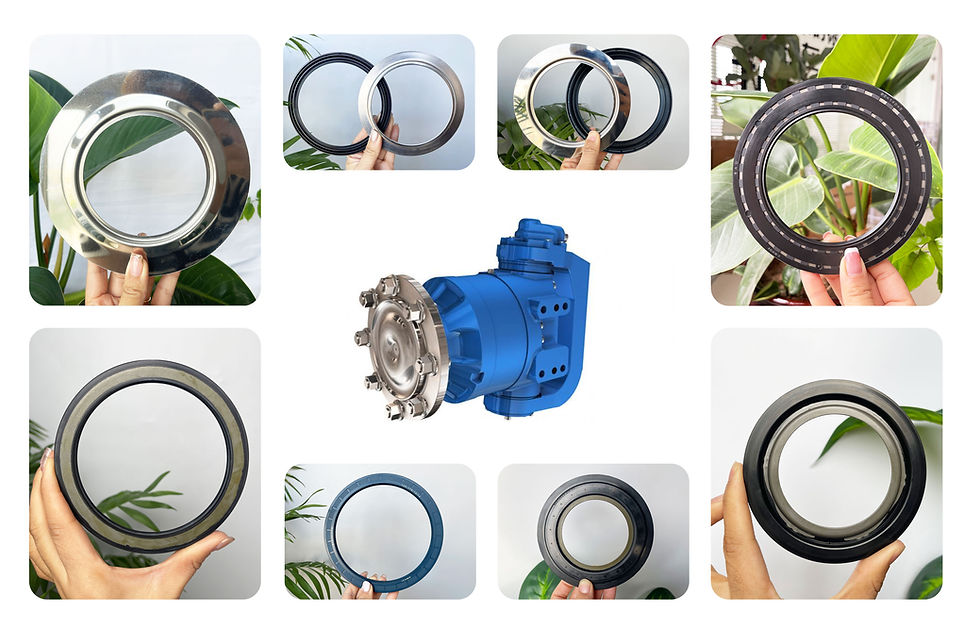
A hydraulic pump may cost thousands of dollars, but one incorrectly selected shaft seal can cause oil leakage, contamination, repeat repairs and unexpected equipment downtime.
For hydraulic pump repair companies, hydraulic motor rebuilders, construction machinery parts distributors and industrial maintenance teams, the biggest challenge is not simply finding an oil seal. It is finding the correct Rexroth high pressure oil seal for the exact pump or motor model.
Two seals may look similar and even share the same inner and outer diameters. However, differences in seal structure, width, material and installation position can completely change their performance.
This guide explains how to select the correct hydraulic pump oil seal and avoid the most common causes of premature leakage.
Why New Hydraulic Pump Seals Fail
When a newly installed oil seal starts leaking, many buyers immediately blame the seal quality.
In reality, early failure may also be caused by:
Incorrect seal size
Wrong sealing lip structure
Incorrect installation direction
Worn shaft surfaces
Excessive case pressure
Restricted drain lines
Installation damage
Incorrect material selection
Shaft runout or bearing play
Contaminated hydraulic oil
Replacing the seal without finding the root cause may only provide a temporary solution.
A reliable repair requires the correct oil seal, proper shaft inspection, hydraulic system diagnosis and controlled installation.
Do Not Select a Rexroth Pump Seal by Size Alone
Many inquiries contain only three dimensions:
We need a 50 × 72 × 7 oil seal.
This information is not always sufficient.
A complete hydraulic pump seal specification should include:
Pump or motor brand
Complete model number
Series and displacement
Inner diameter
Outer diameter
Complete width
Seal structure
Material
Equipment application
Operating conditions
For example, the MEIOU HPS cross-reference lists a 50 × 72 × 7/5 BAFSL1SF VITON seal for several A2FO and A2FE applications.
However, this does not mean every standard 50 × 72 oil seal is suitable.
The complete width and seal structure must also be verified.
Always Confirm the Complete Pump Model
“Rexroth pump seal” is not a complete purchasing description.
Rexroth hydraulic equipment includes many series, such as:
A2FO fixed pumps
A2FE plug-in motors
A2FM fixed motors
A4VG variable pumps
A4VSO variable pumps
A6VM variable motors
A7VO variable pumps
A10V piston pumps
A10VG variable pumps
A11V piston pumps
Different displacements within the same series may use different shaft seal sizes.
For example, smaller A2FO models use a 28 × 40 × 6/5.5 seal, while larger models use specifications such as 35 × 52 × 6/5.5, 45 × 62 × 7 and 60 × 80 × 7/5.5.
A better inquiry is:
High pressure shaft seal required for Rexroth A2FO45 hydraulic pump. Please confirm the correct size, structure and material.
Providing the complete model helps prevent quotation errors and incorrect shipments.
Why Seal Structure Matters
The MEIOU HPS cross-reference includes several oil seal structures, such as:
BAFSL1SF
BABSL10FX2
BAB2SL05
BAFSL1F
BAFSLSF
BAB3SI
These codes represent different sealing structures and should not be ignored.
A general-purpose rotary shaft seal may fit into the housing but still fail under hydraulic pump operating conditions.
Hydraulic pump shaft seals may face:
Continuous rotation
High oil temperature
Pressure fluctuations
Shaft vibration
Long operating cycles
Contaminated environments
For example, the A4VG series uses different dimensions and both BAFSL1SF and BABSL10FX2 seal structures depending on the pump model.
Buyers should therefore match the pump model, dimensions, structure and material, not dimensions alone.
Do Not Ignore Double Width Specifications
Some high pressure oil seals use sizes such as:
35 × 52 × 6/5.5
50 × 72 × 7/5
60 × 80 × 7/5.5
The second width figure is not necessarily a printing error.
It may relate to the seal profile, lip-side structure or installation position.
Replacing a 50 × 72 × 7/5 seal with an ordinary 50 × 72 × 7 oil seal may cause:
Incorrect installation depth
Insufficient support
Lip contact with a worn shaft area
Seal deformation
Premature leakage
Always record every dimension of the removed seal exactly. Do not round the measurements before confirming the original structure.
Is VITON Always the Correct Material?
Most hydraulic pump and motor seals in the cross-reference are listed in VITON.
VITON is commonly used in demanding hydraulic applications because of its resistance to heat and many industrial oils.
However, material selection should also consider:
Hydraulic oil type
Continuous temperature
Peak temperature
Shaft speed
Equipment duty cycle
Pressure fluctuations
Working environment
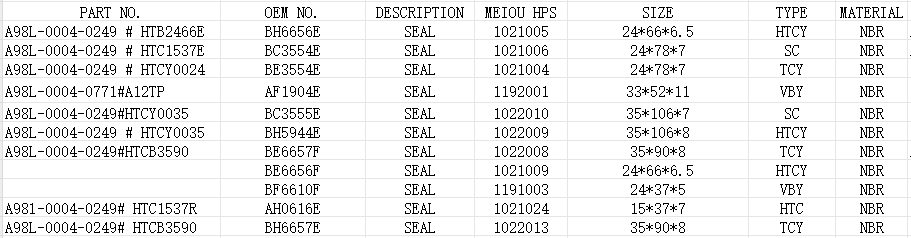
The catalogue also includes NBR seals for certain motor applications, confirming that not every hydraulic system requires the same material.
A high-grade material cannot compensate for the wrong structure, damaged shaft or excessive case pressure.
Inspect the Shaft Before Installing a New Seal
A new hydraulic pump oil seal cannot seal reliably against a damaged shaft.
Before installation, inspect the shaft for:
Wear grooves
Scratches
Rust
Pitting
Burrs
Excessive runout
Bearing play
Misalignment
A worn groove may prevent the sealing lip from maintaining uniform contact.
In this situation, replacing the oil seal alone may not solve the leakage problem. The repair may require shaft restoration, replacement, a suitable repair sleeve or adjustment of the installation position.
Check Case Pressure and Drain Lines
When a new shaft seal is pushed out, deformed or starts leaking immediately, excessive case pressure may be the real cause.
Possible causes include:
Blocked case-drain lines
Restricted filters
Undersized drain hoses
Incorrect hose routing
High oil viscosity during cold start
Excessive internal pump wear
Pressure spikes
A stronger seal may delay failure, but it cannot permanently correct an abnormal hydraulic system.
Before replacing the seal again, inspect the drain circuit and measure the actual case pressure where possible.
Hydraulic Pump Oil Seal Installation Checklist
Before installation:
Confirm the complete pump model
Verify the seal dimensions
Check the seal structure
Confirm the material
Inspect the shaft and housing
During installation:
Clean the housing completely
Protect the lip from splines and sharp edges
Apply compatible lubrication
Press the seal evenly
Confirm the installation direction
Maintain the correct installation depth
After installation:
Rotate the shaft manually
Check for abnormal resistance
Inspect the case-drain line
Test the unit at controlled speed
Monitor leakage and oil temperature
A few minutes of inspection can prevent hours of repeated repair work.
What Information Should Buyers Send?
To receive an accurate quotation, send the supplier:
Pump or motor brand
Complete model number
Old seal dimensions
Seal type or marking
Photos of both sides
Shaft diameter
Housing bore size
Required quantity
Equipment application
Leakage symptoms
Delivery country
A clear inquiry may look like this:
We need a high pressure shaft seal for a Rexroth A4VG hydraulic pump. Please confirm the correct seal according to the complete pump model. Old seal photos and measurements are attached.
For A4VG pumps, the seal dimensions change according to the displacement, so the full model number is essential.
Final Advice
Selecting a Rexroth high pressure oil seal is not simply a matter of finding a similar-looking product.
A reliable process should follow this order:
Confirm the pump model → verify the dimensions → match the structure → confirm the material → inspect the shaft → check case pressure → install correctly
Skipping one step may turn a small oil seal replacement into an expensive repeat repair.
Save this guide for your next hydraulic pump maintenance project.
Need help identifying a Rexroth pump or motor seal? Send us the complete model, old seal dimensions, clear photos and required quantity.
Comment with the hydraulic pump model you are repairing, save this article for future reference and contact us for model matching, wholesale purchasing and custom high pressure oil seal solutions.
#RexrothHighPressureOilSeal #HighPressureOilSeal #RexrothPumpSeal #RexrothMotorSeal #HydraulicPumpSeal #HydraulicMotorSeal #HydraulicShaftSeal #AxialPistonPumpSeal #AxialPistonMotorSeal #VitonOilSeal #RotaryShaftSeal #A2FOSeal #A2FESeal #A2FMSeal #A4VGSeal #A4VSOSeal #A6VMSeal #A7VOSeal #A10VSeal #A10VGSeal #A11VSeal #HydraulicPumpRepair #HydraulicMotorRepair #PumpRepairParts #HydraulicSpareParts #HydraulicRepairShop #PumpRebuilder #MotorRebuilder #OilSealDistributor #OilSealWholesaler #HydraulicPartsImporter #ExcavatorOilSeal #ConstructionMachinerySeal #AgriculturalMachinerySeal #MiningEquipmentSeal #CustomOilSeal #OilLeakageSolution #SealFailureSolution #HydraulicMaintenance #OilSealManufacturer


Comments